

Last Updated on June 24, 2026 by Kittredge Cherry
Rare artworks of a queer Black Jesus and a Black gay church family are presented here along with saints, books and other Black LGBTQ resources in honor of Kwanzaa. The week-long celebration of African American culture starts Dec. 26. Kwanzaa is rooted in African culture, but people of all racial and ethnic backgrounds are welcome to join the holiday.
People celebrate Kwanzaa by giving gifts, lighting a set of seven candles in the African colors of red, green, and black, and sharing an African feast on New Year’s Eve. Each of the seven days honors a principle from African heritage: unity (umoja), self-determination (kujichagulia), collective responsibility (ujima), cooperative economics (ujamaa), purpose (nia), creativity (kuumba), and faith (imani). Kwanzaa was created in 1965-66 by Maulana Karenga, chairman of Black studies at California State University in Long Beach based on harvest festivals in Africa.
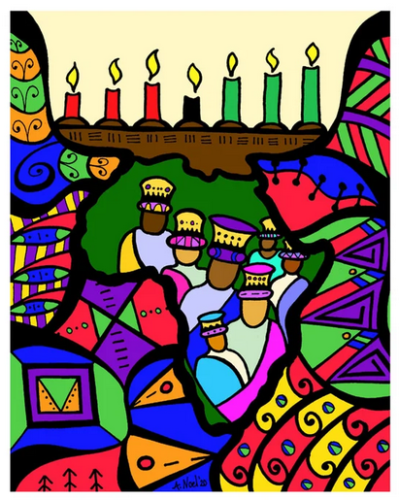
“Joyous Kwanzaa” by Andrea Noel
During Kwanzaa, it is customary to greet others with the Swahili phrase “Habari gani,” which means “What’s the news?” The proper response is to say the principle of the day.
“Kwanzaa is not a religious holiday, but a cultural one with an inherent spiritual quality,” Karenga writes on the official Kwanzaa website. Kwanzaa can be celebrated in addition to Christmas or as an alternative to it. Many families and congregations have adopted Kwanzaa into their spiritual life. It joins other winter holidays including the 12 days of Christmas, the eight nights of Hanukah and the LGBTQ-focused Bridge of Light week.
Karenga welcomes people to celebrate Kwanzaa in different ways. “The original vision and values of Kwanzaa must be maintained… However, two principles of Kwanzaa encourage creativity, diversity and flexibility within this general rule. These are Kuumba (creativity) and Kujichagulia (self-determination),” he wrote.
In that spirit, this blog highlights a variety of Black LGBTQ Christian resources as Kwanzaa begins.
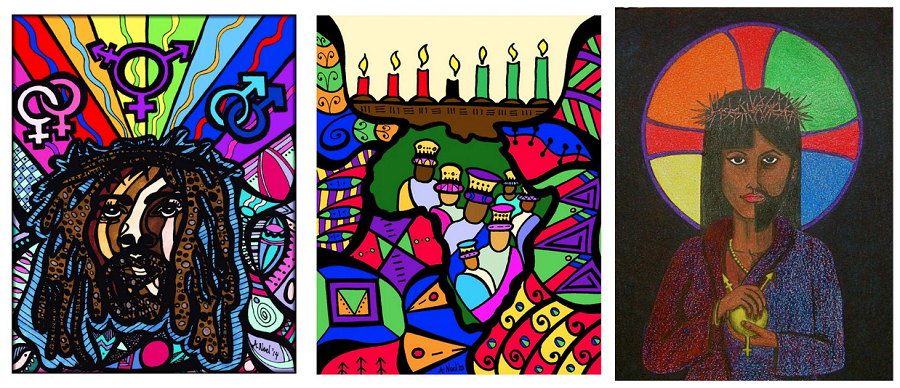
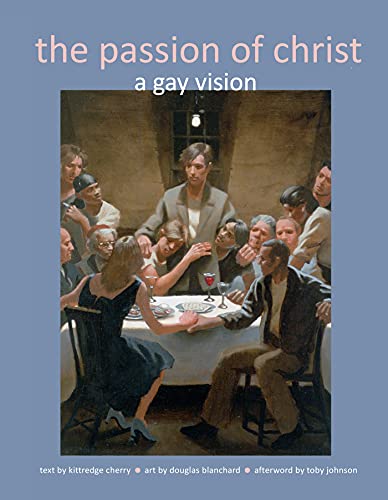
It’s almost impossible to find a Christ figure that expresses both LGBTQ identity AND non-white racial / ethnic identity. “Jesus for All” by Andrea Noel and “Neither” by David Hayward are two of these uncommon treasures. Others can be seen on Q Spirit’s article Black Jesus, Latinx Jesus, female Christ and other liberating visions join the gay Passion of Christ.
New in 2025: Black saints embody Kwanzaa ideals
Kwanzaa principles are embodied in the lives of various LGBTQ African American saints and historical figures who are featured at Q Spirit.
Click the following links for full profiles of the following:
The Two Rebeccas: Queer Black pair founded Shaker religious community in 1800s
William Dorsey Swann: From slavery to queer freedom in 1880s as America’s first drag queen
Bayard Rustin: Gay saint of racial justice and non-violence
Delores Berry: Black lesbian evangelist blessed many with music
Carl Bean: Black LGBTQ church founder who sang “I Was Born This Way”
Pauli Murray: Queer saint who stood for racial and gender equality
Marsha P. Johnson: African American transgender woman helped start Stonewall Uprising
Sandra Robinson: Black lesbian MCC clergywoman educated and inspired
Grant-Michael Fitzgerald: Pioneering black gay Catholic brother advocated LGBTQ rights in 1970s
La Paula Turner: Black lesbian clergy pioneer opened doors
James Tinney: Black gay professor who founded LGBTQ church in 1982
Peter Gomes: Gay black Harvard minister preached “scandalous gospel”
The following African Americans are included on Q Spirit’s Calendar of LGBTQ Saints, with full profiles planned for the future:
Feb 3 – Elizabeth Lange, an African American woman who was declared “venerable” by the Pope, had a female soulmate and long-time companion. Lange and her “good friend” Marie Magdalene Balas were refugees from Haiti who lived together and operated a school for black girls out of their home in Baltimore for ten years from 1817 to 1827. The two women went on to found the oldest Catholic school for African Americans in 1828. They both felt a religious calling. Lange is recognized as the founder of the first order of African American nuns in the United States, the Oblate Sisters of Providence. She became mother superior and Balas was one of the original nuns in the order. Lange is in the first stage of the canonization process on the path to sainthood in the Roman Catholic church after being declared “venerable” by the Pope in 2023. She died on Feb. 3, 1882.
Feb. 24 – Octavia Butler (June 22, 1947 – Feb. 24, 2006) Black lesbian science-fiction writer whose work included queer characters and African American spiritualism.
May 22 – Langston Hughes (Feb 1, 1901 – May 22, 1967), African American writer, likely gay
June 17 – Pat Parker (Jan 20, 1944 – June 17, 1989) African American lesbian feminist poet
June 28 – Clarence Henry Cobbs (Feb. 29, 1908 – June 28, 1979) was an African-American clergyman who founded one of Chicago’s largest churches, the First Church of Deliverance, in 1929. The church welcomed black LGBTQ people and its founding pastor was known to be “that way” himself.
July 15 – Ernestine Eckstein (April 23, 1941 – July 15, 1992) lesbian activist who was one of the only women — and the only black woman — present at early LGBTQ rights protests such as the “Annual Reminder.“
Nov. 17 – Audre Lorde (18 Feb 1934 – 17 Nov 1992), African American lesbian poet
Nov. 28 – Rita Hester (Nov 30, 1963 – Nov 28, 1998), African American transwoman. Transgender Day of Remembrance was founded to memorialize her murder.
Dec. 1 – James Baldwin (Aug 2, 1924 – Dec 1, 1987) gay African American writer
Frances Thompson, died 1876, black transgender freedwoman, anti-rape activist and first transwoman to testify before Congress.
Black Christ affirms LGBTQ people in “Jesus for All”
A black Christ welcomes LGBTQ people in “Jesus for All” by Andrea Noel, an Afro-Caribbean artist based in Baltimore. Her Jesus expresses queer solidarity through bright rainbow colors that stream from the head of Christ. The rainbow rays include LGBTQ symbols: linked female signs, linked male signs and a transgender symbol. This Jesus has dreadlocks and dark skin marked with lighter streaks that unite him with all races. He is surrounded by dynamic patterns inspired by Noel’s Trinidadian roots.
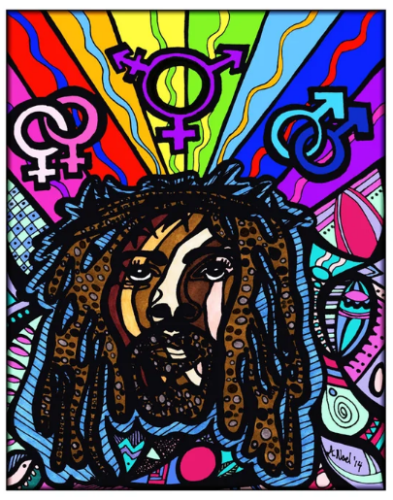
“Jesus for all” by Andrea Noel
She is a self-taught artist, born in Selma, Alabama, but raised in Trinidad and Tobago. Noel developed her artistic style 20 years ago by drawing with Sharpie markers to reduce stress from her demanding classes as a chemical-engineering student at Howard University in Washington, DC.
“Over time, drawing moved from a stress reliever, to a spiritual practice, and now my life’s work,” Noel writes on her website anoelcreatesart.com. “… My goal as an artist is to inspire customers and clients to manifest the passions inside of them that will nurture soulful connections to self, others, and the Sacred.”
Noel’s “Joyous Kwanzaa” piece is also featured here for the holilday. It shows the seven-branched Kwanzaa kinara or candelabra with candles burning brightly in Noel’s characteristic bold, vibrant style. She illustrates a variety of themes, including social justice, LGBTQ, women, spirituality, and Christianity.
“Neither” reveals a queer black Jesus
“Neither” shows a dark-skinned Jesus who is male on one side and female on the other in the style of the Hindu deity Ardhanarishvara. He/she has a rainbow halo and holds a transgender symbol.
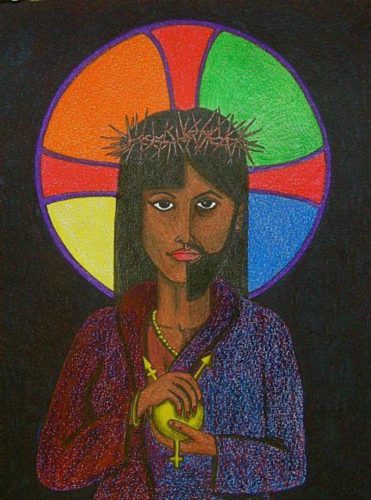
“Neither” by David Hayward
The title “Neither” comes from the Bible: “There is neither Jew nor Greek, there is neither slave nor free, there is neither male nor female; for you are all one in Christ Jesus.” (Galatians 3:28). Thus it embodies Kwanzaa principles of unity and faith.
“Neither” was painted by Canadian artist David Hayward, also known as Naked Pastor. The Canadian artist uses gentle humor to open hearts, minds and church doors to LGBTQ people and others who have been excluded. He has a master’s degree in theology and 30 years of pastoral experience. This artwork and many more are available at the Nakedpastor website. Click for more cartoons and info.
“Bless This Family” shows black gay couple as gospel singers
Kwanzaa is often seen as a holiday about family togetherness and fun for children, but it’s hard to find images of black LGBTQ families in a Christian context. One of these exceptional images is “Bless This Family” by Felix d’Eon, a Mexican Latinx painter and activist dedicated to the art of queer love, romance, and sensuality.
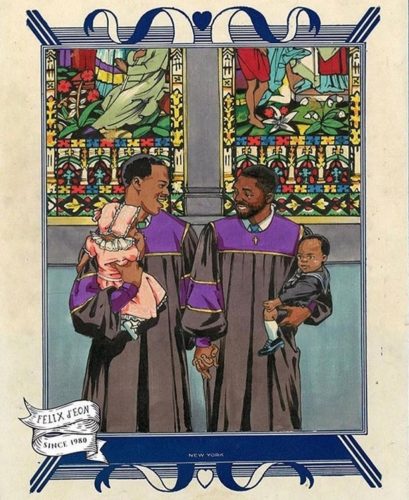
“Bless This Family” by Felix d’Eon.
“Bless This Family” shows a black gay couple as gospel singers in choir robes. They are holding hands in front of a stained-glass window with their children in their arms. The models for the painting are Terrell and Jarius Joseph of Atlanta and their two-year-old twins Ashton and Aria. Terrell and Jarius are a married couple and “social media influencing brand” who blog about gay parenting.
Black and queer liberation theologies
Black theologian James Cone advocated powerfully for the black Jesus. In his classic 1970 book “A Black Theology of Liberation,” he wrote:
The blackness of God means that God has made the oppressed condition God’s own condition. This is the essence of the Biblical revelation. By electing Israelite slaves as the people of God and by becoming the Oppressed One in Jesus Christ, the human race is made to understand that God is known where human beings experience humiliation and suffering.”
It may be useful to ask: How does the blackness of God relate to the queerness of God and the gay Jesus? Where does the queer black Jesus fit? Cone objected to consistent portrayals of Jesus as white, just as queer theologians question the pervasive heterosexual assumptions about Jesus.
Cone discussed the value the black Jesus in a 1989 interview with USA Today, using arguments similar to what queer theologians say about the queer Christ:
It’s very important because you’ve got a lot of white images of Christ. In reality, Christ was not white, not European. That’s important to the psychic and to the spiritual consciousness of black people who live in a ghetto and in a white society in which their lord and savior looks just like people who victimize them. God is whatever color God needs to be in order to let people know they’re not nobodies, they’re somebodies.
Queer Christ figures provide the same service by showing LGBTQ people that they are somebodies. Cone himself sees the connections. In a 2015 interview, he told Huffington Post, “God is red. God is brown. God is yellow. God is gay…I don’t use blackness as a way to exclude anyone.”
Queer Kwanzaa in community
A video by black feminist Alexis Pauline Gumbs introduces the queer traditions for celebrating Kwanzaa as a community practice in New York City and Detroit, Michigan.
Queer Kwanzaa: A MobileHomecoming PSA from Alexis Pauline Gumbs on Vimeo.
LGBTQ African American Christian books
Recent books on LGBTQ African American Christians and related subjects are highlighted here as an extra Kwanzaa gift:
2026
“Inclusive Love: Seeing the Black Church in the Rainbow” by Ralph Watkins. Foreword by Yvette Flunder, pastor of City of Refuge United Church of Christ. Published by Judson Press.
2025
“And God Said… Let There Be Dykes: Queer, Bold & Biblical” by Essie Linzy. Independently published.
“Boy, Interrupted: A Southern Memoir of Faith, Identity, and Becoming” by William C. Scandrett. Published by Swift Creek Publishing Company, Queer Black boy finds faith can evolve while growing up in rural Georgia.
“Public Theology and Violent Rhetoric Examined in a Queer Womanist Critical Ethnography” by Teresa L. Smallwood.
2024
“A Blackqueer Sexual Ethics: Embodiment, Possibility, and Living Archive” by Elyse Ambrose. Published by T&T Clark, an imprint of Bloomsbury Publishing.
“UBUNTU and the Word: A Primer for Afrodiasporan Biblical Rhetoric” by Corey L Brown. Published by Writeontime.
“Queering Black Churches: Dismantling Heteronormativity in African American Congregations” by Brandon Thomas Crowley. Published by Oxford University Press.
“Jimmy’s Faith: James Baldwin, Disidentification, and the Queer Possibilities of Black Religion” by Christopher Hunt. Published by Fordham University Press.
“God is The Great Black Mother and Her Son was Queer: A Poetic Theology of Culture: Exploring Theological Matricide and Intersectionality in the Divine Feminine” by Donald Henry Matthews (author) and Faith Donna Marada Matthews (illustrator). Independently published.
2023
“Hidden Histories: Faith and Black Lesbian Leadership” by Monique Moultrie. Published by Duke University Press.
“Holy Queer: The Coming Out of Christ” by Karmen Michael Smith.
“Alabama Grandson: A Black, Gay Minister’s Passage Out of Hiding” by Cedrick D. Bridgeforth.
“The #BlackLivesMatter Movement: Toward an Intersectional Theology” by Edward Donalson III.
“Black, Gay, British, Christian, Queer: Church and the Famine of Grace” by Jarel Robinson-Brown.
“Proclaim! Sharing Words, Living Examples, Changing Lives: An Exploration of Episcopal Liturgy from a Black, Queer, Millennial Perspective” by Marcus George Halley.
“Black Trans Prayer Book” by J Mase III and Lady Dane Figueroa Edidi (editors).
“God, a Lesbian, and the Space in Between” by Michelle Johns.
“Pauli Murray: A Personal and Political Life” by Troy R. Saxby.
“Bayard and Martin: A Historical Novel About Friendship and the Civil Rights Movement” by Frederick Williams, Lane Denton, and Sterling Zinsmeyer.
“Filled with the Spirit: Sexuality, Gender, and Radical Inclusivity in a Black Pentecostal Church Coalition” by Ellen Lewin.
“Live Through This: Surviving the Intersections of Sexuality, God, and Race” by Clay Cane.
“Blackpentecostal Breath: The Aesthetics of Possibility” by Ashon T. Crawley.
“Religion, Flesh, and Blood: The Convergence of HIV/AIDS, Black Sexual Expression, and Therapeutic Religion” by Pamela Leong.
“Our Lives Matter: A Womanist Queer Theology” by Pamela R. Lightsey.
“LGBT: In The Name of God: The Black Church’s Response to the LGBT Community” by Christopher James Priest with a foreword by Benjamin L. Reynolds.
“A Queering of Black Theology: James Baldwin’s Blues Project and Gospel Prose” by E.L. Kornegay.
“In the Life and in the Spirit: Homoerotic Spirituality in African American Literature” by Marlon Rachquel Moore.
[This article was attacked on Dec. 24, 2024 in a post titled “Celebrating Kwanzaa With Blasphemous LGBT Art” at the an extreme right-wing hate site Moonbattery. It’s one of many hate articles that denounce Q Spirit. “Moonbattery” is an insult that means “left-wing lunacy.”]
Happy Kwanzaa from Kittredge Cherry and the Jesus in Love blog at Q Spirit! Habari gani?
___
Related links:
Queering Kwanzaa: How the seven principles remind me of QTPOC power (Black Youth Project)
___
Top image credit:
Left to right: “Jesus for All” by Andrea Noel, “Joyous Kwanzaa” by Andrea Noel, and “Neither” by David Hayward. Prints are available at ANoelCreatesArt.com and Nakedpastor.com.
___
This post is part of the LGBTQ Calendar series by Kittredge Cherry. The series celebrates religious and spiritual holidays, events in LGBTQ history, holy days, feast days, festivals, anniversaries, liturgical seasons and other occasions of special interest to lesbian, gay, bisexual, transgender and queer people of faith and our allies.
This article was originally published on Q Spirit in December 2016, was expanded with new material over time, and was most recently updated on April 18, 2026.
Copyright © Kittredge Cherry. All rights reserved.
Qspirit.net presents the Jesus in Love Blog on LGBTQ spirituality.



















This article, the artwork it speaks about and christianity literally have zero to do with Kwanzaa. If the writer had done some actual research instead of a quick google search, maybe she would have seen that.
I’m doing what I can to celebrate African American culture and educate myself and my readers.